

Francesco Aprile
from Singular Vispo, Coldfront magazine, edited by Nico Vassilakis in 2016
Francesco Saverio Dòdaro (Bari, ITA, 1930 – Lecce, ITA, 2018) was poet, visual poet, essayist, writer, literary and art theorist. In 1976, Dòdaro founded the Genetic Movement that is located in Lecce, Genova, and Toronto (here with the complicity and collaboration of Amerigo Marras and C. E. A. C. Toronto), based on the Mukarovsky-Lacan-Bowlby-Fonagy co-ordinates. He placed the poetic condition in the mourning processes, which are caused by amniotic separation. The matrix of the Dòdaro’s theory is a language considered as a conjunction – Language is a conjunction. Language is an ‘and’ (Dòdaro, Dichiarazione onomatopeica, Lecce, Ghen Arte, 1979) – owing to a Lacanian manque à être, that is the primary cause of the separation of the subject from the maternal complement (Dòdaro, Codice Yem, Lecce, Ghen Arte, 1979). All human languages have sound. Dòdaro found that sound in pre-natal heart-beats (of both mother and foetus).
Francesco Saverio Dòdaro theorized the rhythmical archetype of poetical languages. According to the Genetic theory, mother and foetus were the archetype dual-principle and language was a link to the dual-unity. In this movement, he launched the experimental magazine “Ghen”, a modular journal about experimental languages and theoretical texts about art and literature. Dòdaro says that the module is the unit of measure of thought. The Genetic Movement had two magazines: Ghen (ideated by Francesco Saverio Dòdaro, published in Lecce, Italy) and Ghen res Extensa Ligu (directed by Rolando Mignani in Genova). His works and books of visual-poetries are archived in libraries, centres of documentation, Italians and strangers, like the Archivio di Nuova Scrittura (Mart, Trento/Museion, Bolzano), The Sackner Archive of Visual and Concrete Poetry, Civica Galleria Arte Moderna (Gallarate), Biblioteca Nazionale Centrale di Firenze, Imago Mundi-Visual Poetry in Europe (Benetton Foundation-Sarenco Foundation), Hokkaido Museum of Literature, Mercato del Sale, Museo Provinciale Sigismondo Castromediano (Lecce, Italy). Since the ’80 Dòdaro founded some of the most revolutionary and impressive editions of literary research:
«Ghen arte» (Lecce, 1978), «Violazioni estetiche» (Lecce, 1981), «Scritture» (Parabita, 1989), «Spagine. Scritture infinite» (Caprarica di Lecce, 1989), «Compact Type. Nuova narrativa» (Caprarica di Lecce, 1990), «Diapoesitive. Scritture per gli schermi» (Caprarica di Lecce, 1990), «Mail Fiction» (Caprarica di Lecce, 1991), «Wall Word» (Lecce, 1992 ), «International Mail Stories» (Lecce, 1993), «Internet Poetry» (Lecce, 1995), «Walkman Fiction. Romanzi da ascoltare» (Lecce, 1996), «E 800 European Literature», in five different languages (Lecce, 2000), «Pieghe narrative» (Lecce, 2001), «Pieghe poetiche» (Lecce, 2001), «Pieghe della memoria» (Lecce, 2001), «Foglie nude» (Doria di Cassano Jonio, 2003), «Locandine letterarie» (Lecce, 2005), «Romanzi nudi» (Lecce, 2006-07), «Carte letterarie» (Lecce, 2009), «792 Mail Theatre» (Lecce, 2009), «New Page. Narrativa in store», (Lecce, 2009), «New Page. Theatre in store» (Lecce, 2010), «New Page. Poetry in store» (Lecce, 2011).
“Scritture” (1989) is a collection of visual poetry books in post-card format. In this series are present Francesco S. Dòdaro, Ugo Carrega, Luciano Caruso.
“Spagine” (1989) is a collection of poster works of visual poetry and experimental poetry by some interesting authors (Dòdaro, Caruso, Stelio M. Martini, Elisabetta Gut, Franco Gelli and so on).
“Compact Type” (1990) brief fiction, novels in three folders.
“Diapoesitive” (1990) visual poetry and experimental literature to be projected.
“Mail Fiction” (1991) short narrations, novels on post-card.
“Wall Word” (1992) is the first international experience of concrete narrative, narrative wall, concrete-narrative wall. Authors: Francesco S. Dòdaro, Lamberto Pignotti, Eugenio Miccini, Richard Kostelanetz, Jean-Francois Bory, Julien Blaine, Alain-Arias Misson, Castellano, Shoachiro Takahashi, Henry Chopin, Bartolomé Ferrando. This series was translated into Japanese and exposed in the Hokkaido Museum of Literature.
“Internet Poetry” (1995) was a collection of poetry founded and directed by Francesco Saverio Dòdaro in 1995 for Conte Editore in Lecce. The “Internet poetry” collection was composed of two editions: web and print edition. The first title published was “Three deserts from the shadow of the last mechanical smile” (1995) by Elio Coriano, Venice Poetry Prize in 1996. Poetry as iper-text was published on the web of ClioCom (www.clio.it/sr/ce/ip/home.html), and today is no more online. “Internet Poetry” was the first Italian experience of net poetry.
“New Page” (2009) is a literary movement which was supported by authors from around the world: (Italy) Francesco Saverio Dòdaro, Teresa Maria Lutri, Elisabetta Liguori, Francesco Aprile, Mauro Marino, Antonio Palumbo, Rossano Astremo, Elio Coriano, Serena Stìfani, Giuseppe Cristaldi, Vito Antonio Conte, Stefano Donno, Giuliano Ingrosso, Lea Barletti, Francesco Pasca, Marianna Massa, Erika Sorrenti, Alessandra De Luca, Ennio Ciotta, Dino Levante, Domenico Ingenito, Cristiano Caggiula, Vincenzo Lagalla, Marina Pizzi, Fabio Orecchini. / (Belgium) Luc Fierens / (Spain) Bartolomé Ferrando, Patricia Aguilera Arroyo / (USA) John Bennett / (Canada) Elvira Cordileone / (Malta) Victor Jacono / (Egypt) Ahmed Hamed Ahmed / (France) Vanessa Bile-Audouard / (Syria) Ayham Agha / (Ukraine) Volodymyr Bilyk, Julia Stakhivska, Julia Guz, Oleh Lysheha, Andriy Antonovskiy, Lyubov Iakymchuk, Eugene Dovgyj / (Algeria) Bouzid TemTem / (Romania) Gheorghe M. Neguțu. New Page included short fiction, a hundred words, inspired by the advertising. Each text is printed by the individual authors in the 70×100 format and is mounted on crowner (hardbacks panels used in advertising). The works are not sold and their circulation is free. They are on display in shop windows. Dòdaro says that “the storyteller of the new millennium is not in the streets, but in the shop windows”.

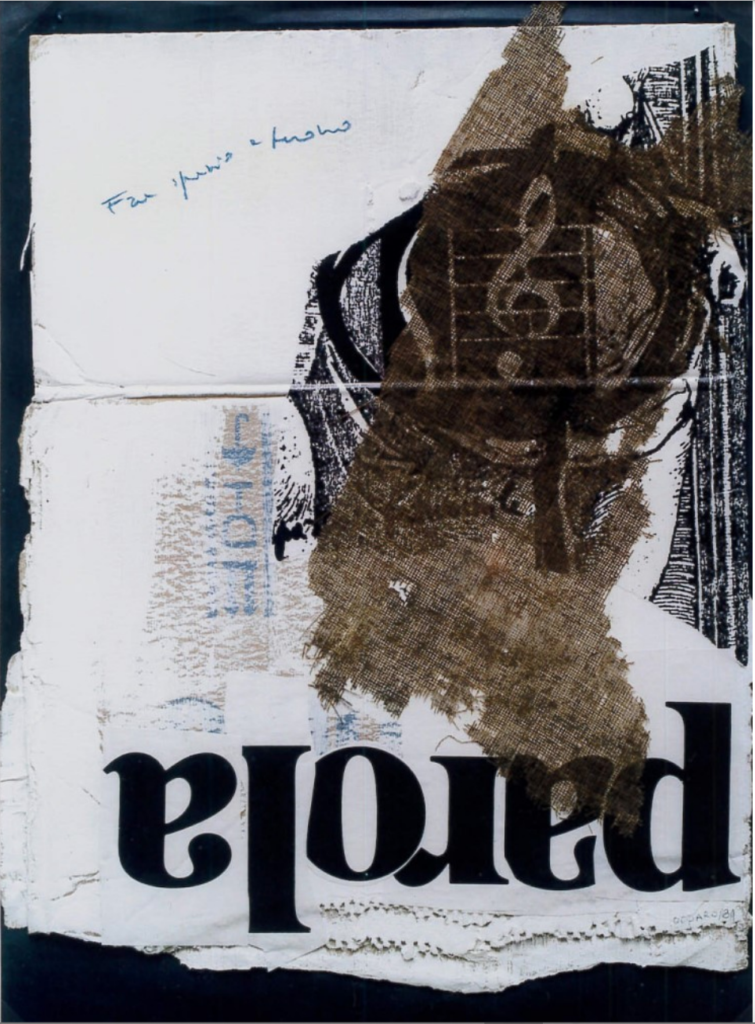
suono. Situazione italiana, Viareggio, 1984