by Francesco Aprile
first publication in Utsanga.it 2016
then in Digicult 2018, then in Kermes 2018, then in Perspektive avantgarde-boot-camp 2020
The recent history of writing provides a large part of the context for the reception of information technology in literature. It is also because the media describes and connotes the historical context. Throughout human history, the first iconic representations were action instruments on reality. Therefore, it is easy to see how information technology has created a structural relation between images and objects. But before imposing itself as a point of visualization, it changed the conditions of object models creation. We live in a time which represents a new tribalism of image where aleatory data is as real as a physical object. At this point, immateriality is reality.
New digital and social media forms, such as smartphones and smartwatches, have diluted life on a cross-platform like an existential system. Therefore this media hasn’t extended people’s organs, but their lives. Thus, the individual is weak and extremely decentralized. He is fluid and diluted on several devices in addition to himself.
The centre of this study is the innovation of the use of personal computers. It is necessary to go back to 1959 when Theo Lutz with a “Zuse Z22” created the first combinatory writing system based on Kafka’s “Castle”.
Not every look is near. No village is late.
A castle is free and every farmer is distant…[1]
Lutz considered language as a network. His research indeed has enlarged the action fields of information technology, opening it up to an unknown world of literature and art.
The machine was used to generate stochastic texts i.e. sentences where the words are determined randomly. The Z 22 is especially suited to applications in extra-mathematical areas. […] The machine then produces sentences in this language. It seems to be very significant that it is possible to change the underlying word quantity into a “word field” using an assigned probability matrix, and to require the machine to print only those sentences where a probability exists between the subject and the predicate which exceeds a certain value. In this way it is possible to produce a text which is “meaningful” in relation to the underlying matrix[2].
According to Lutz, we consider much important probabilistic character of the computing system. On the same line, Nanni Balestrini created the first Italian poem written on a personal computer. It was 1961. Part of the result was published under the name of “Tape Mark I” in 1962 on the “Almanacco Bompiani”. Several authors passed through the complex paths of the language, eventually ending up in electronic literature. Among these authors, we find Marc Adrian (Text I, 1963), Jean Baudot (La machine à écrire, 1964), the exhibition “Cybernetic Serendipity-The Computer and the Arts” (at Institute of Contemporary Arts of London, 1968), Jackson McLow (1969), BP Nichol (Self-Reflexive n. 1, 1984) and many others. All of these are not yet examples of code poems but first expressions of electronic literature.
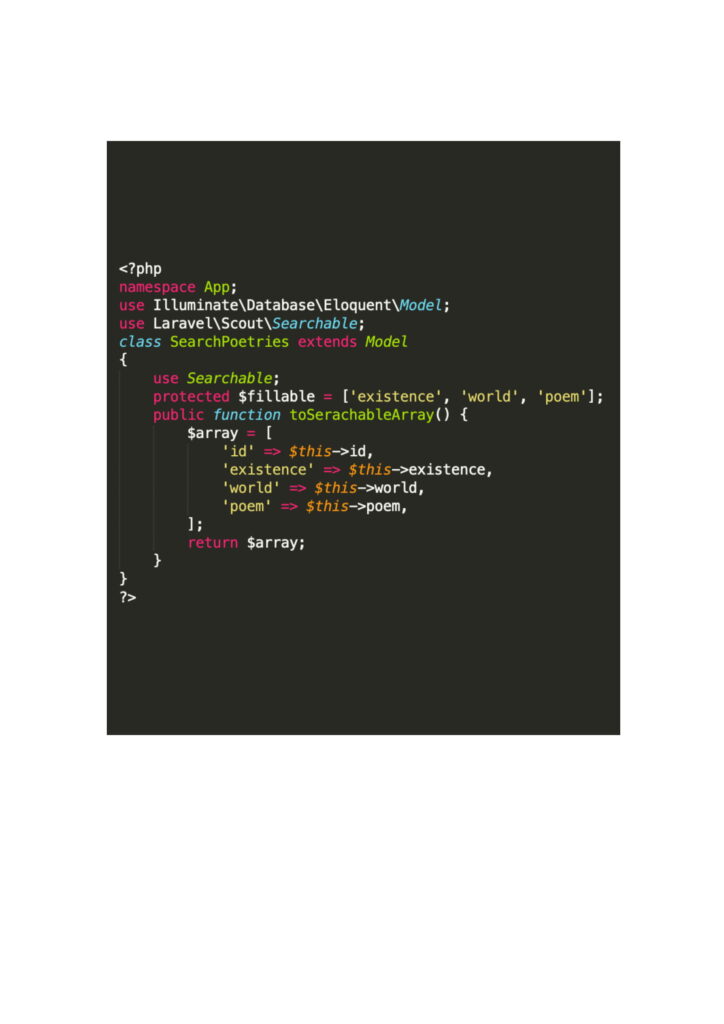
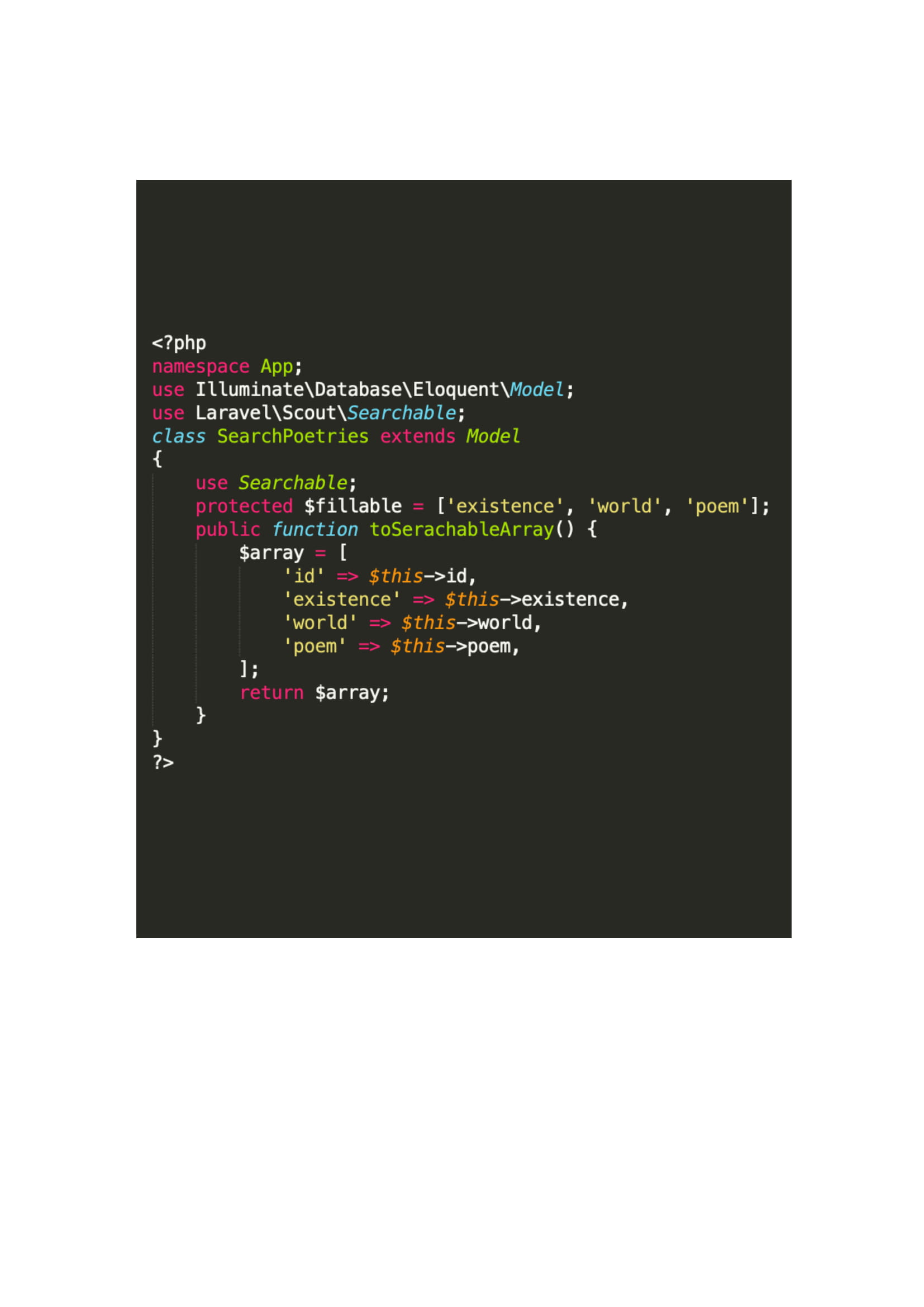
The parable of code poem starting when production costs of personal computers down encouraging the high circulation of it as domestic appliances. In 2002 the poet and software developer Richard Gabriel created the expression “code is poetry” while a year earlier the experimental poet Alan Sondheim used the term “Codework” to describe the attitude to use code in different ambients than software development. Undoubtedly the expression coined by Sondheim contains the code poem concept, but it is also more extensive. Instead, one of first forms of code poem appeared in 1973 by Archie Donald under the name of “Timesharing: Conditional Jump”. As a matter of fact, he presented some fragments of code like a poem. In 2001, during the festival “d-i-n-a” (Digital Is Not Analog 01), the group of epidemiC commissioned at philosopher Franco Berardi the reading of the virus Loveletter.vbs. This action brought the Dada power, impetuosity and irony in the use of code in literature.
What’s this code poem again? Roland Barthes described language as a network characterized by open textuality. Each node of this network is a skin that rubs itself with other nodes (language-skin). Come back with its importance the Lutz’s thinking about language. The network concept then reveals a connection between codes and common human language. Nature of code is polyvalent, thus we consider it as a plural entity. According to Florian Cramer, we can read code as software, but also like a poem. Code poems are cracks in the technical workflow, a poetic manumission in a foreign language to poetry. Codes reveal the differential state of themselves as writing and poem, but these are always codes (code poems).
[1] Lutz T., Stochastic texts, in: augenblick 4 (1959), H. 1, S. 3-9, now in netzliteratur.net.
[2] Ibidem.